Producer >
Château Sociando-Mallet holds a distinguished place in the modern Bordeaux landscape, admired for its unwavering independence and consistently high quality. Eschewing the constraints of the region’s historic classification system, it proudly presents itself simply as Haut-Médoc—letting the wine speak for itself rather than relying on hierarchy.
Under the vision of Jean Gautreau, who acquired the estate in 1969, the property was transformed from a neglected holding into one of the Médoc’s most respected names. Gautreau recognised the inherent brilliance of the terroir and spent decades refining both vineyard and cellar, establishing a benchmark for excellence outside the classified growths.
The estate’s gravelly soils mirror those of elite neighbours such as Château Pichon Longueville Comtesse de Lalande and Château Léoville-Las Cases, enabling the production of wines with comparable depth, structure, and ageing potential. True to its heritage—its name drawn from two historic families—Sociando-Mallet crafts wines that combine power with precision, earning a devoted following among collectors and connoisseurs alike.
Today, the estate produces its flagship Grand Vin, Château Sociando-Mallet, alongside its refined second wine, La Demoiselle de Sociando-Mallet—both exemplifying the estate’s signature style of classic, age-worthy Bordeaux with exceptional pedigree and value.
Viticulture >
Planting density: ~8,300 vines/ha
Average vine age: ~30–35 years
Grape composition (typical):
Cabernet Sauvignon: ~40–55%
Merlot: ~40–55%
Cabernet Franc: ~5%
Traditional vineyard practices with minimal intervention; yields often left to natural variation, contributing to the estate’s distinctive style.
Winemaking >
Fermentation in temperature-controlled stainless steel and cement vats.
Malolactic fermentation in tank.
Aging: ~12 months in French oak, typically with a high proportion of new barrels (often close to 100%).
Annual production: ~20,000–35,000 cases of the grand vin

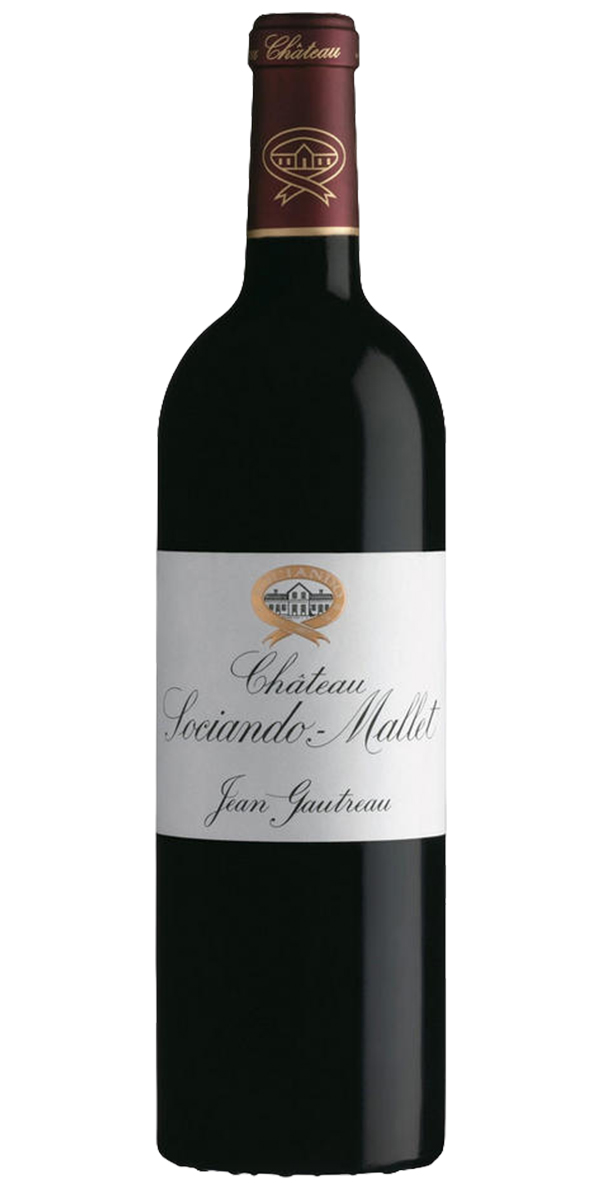
 Merlot (50%), Cabernet Sauvignon (47%), Cabernet Franc (3%)
 Red
Red 14%
14% France
 Haut-Médoc
 6
6 Cork
Cork Yes
Yes Château Sociando-Mallet
 Ready - youthful (2022 - 2044)
 Yes
Yes 75cl
75cl HVE
HVE Vegetarian
  Fact Sheet